


Younalize cuts sports dataset preparation from weeks to days with CVAT Online

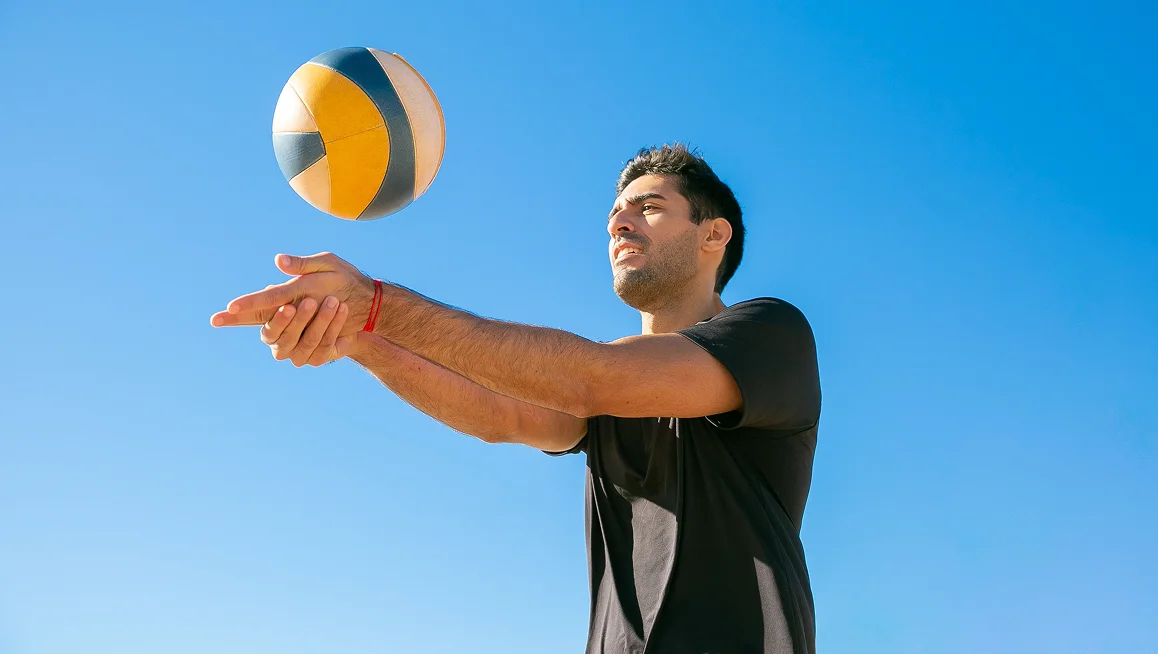

Younalize is a Dutch sports technology company that develops an AI-powered mobile coaching app for volleyball players and coaches. The app analyzes short smartphone videos and delivers near-real-time visual and written feedback on technique.

Younalize needed reliable pose and ball detection across short smartphone videos recorded in inconsistent lighting, angles, and environments. Public sports datasets did not capture the blur, occlusion, and visual variation of real training footage, while manually annotating every frame was too slow for a two-person team.
After testing CVAT Community locally, Younalize moved to CVAT Online for shared access and connected custom YOLO and SAM 2 models through the API. Model-assisted annotation turned most labeling into focused verification and correction, supporting an overnight retraining loop.
Dataset preparation dropped from weeks to days. The two founders can review four or five short clips in under 30 minutes, retrain models overnight, and improve difficult cases without building a dedicated annotation team.
Getting meaningful coaching feedback in volleyball, or any sport, has always required access to a qualified coach. For the hundreds of millions of recreational and developing players who train without that access, technique errors go uncorrected and improvement stalls.
Younalize was founded to change that. Built by developer Fabian van Schevikhoven and veteran volleyball coach Matt van Wezel in the Netherlands, the app uses computer vision and biomechanical analysis to deliver expert-level technique feedback to any player with a smartphone. CVAT Online sits at the heart of the data pipeline that makes it possible.
Using computer vision to make sports coaching more accessible
The idea began with co-founder Matt van Wezel, an experienced volleyball coach who has worked with national programs and teams in several countries. He initially approached co-founder Fabian van Schevikhoven with a marketplace concept: international players spend significant time traveling and waiting in airports, so perhaps they could be paid to review videos and give developing athletes technical feedback.
The coaching method made sense. Matt often paused a video at the exact moment a player jumped, contacted the ball, or moved an elbow into the wrong position. A still frame gave the athlete a clear point of reference that was easier to understand than general feedback over a moving clip. The economics were harder. The athletes who most needed accessible coaching were not necessarily able to pay elite players for repeated reviews.
That pushed the founders toward computer vision. Early experiments with pose estimation showed that body keypoints could be used to measure joint angles and movement phases. Ball detection added the context needed to understand when contact occurred. The concept evolved from a human review marketplace into an AI-assisted coach that could provide consistent feedback on demand.
Bringing AI coaching to the volleyball court
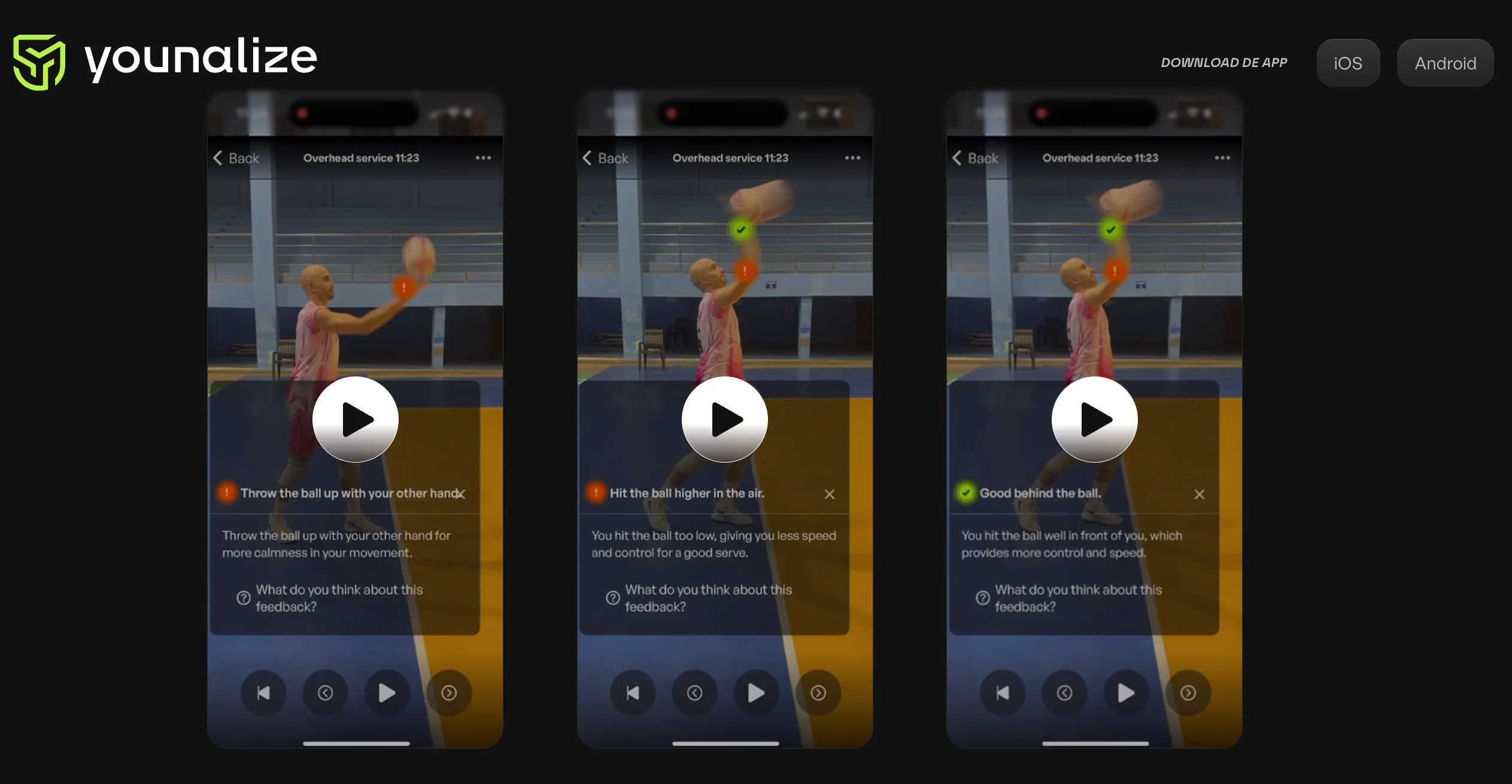
Younalize is built around a four-step workflow. A player opens the app, selects a technique (jump serve, float serve, forearm pass, overhead pass, spike, or one of seven total techniques currently supported), records or uploads a short video clip, and within seconds receives annotated feedback overlaid directly on the footage.
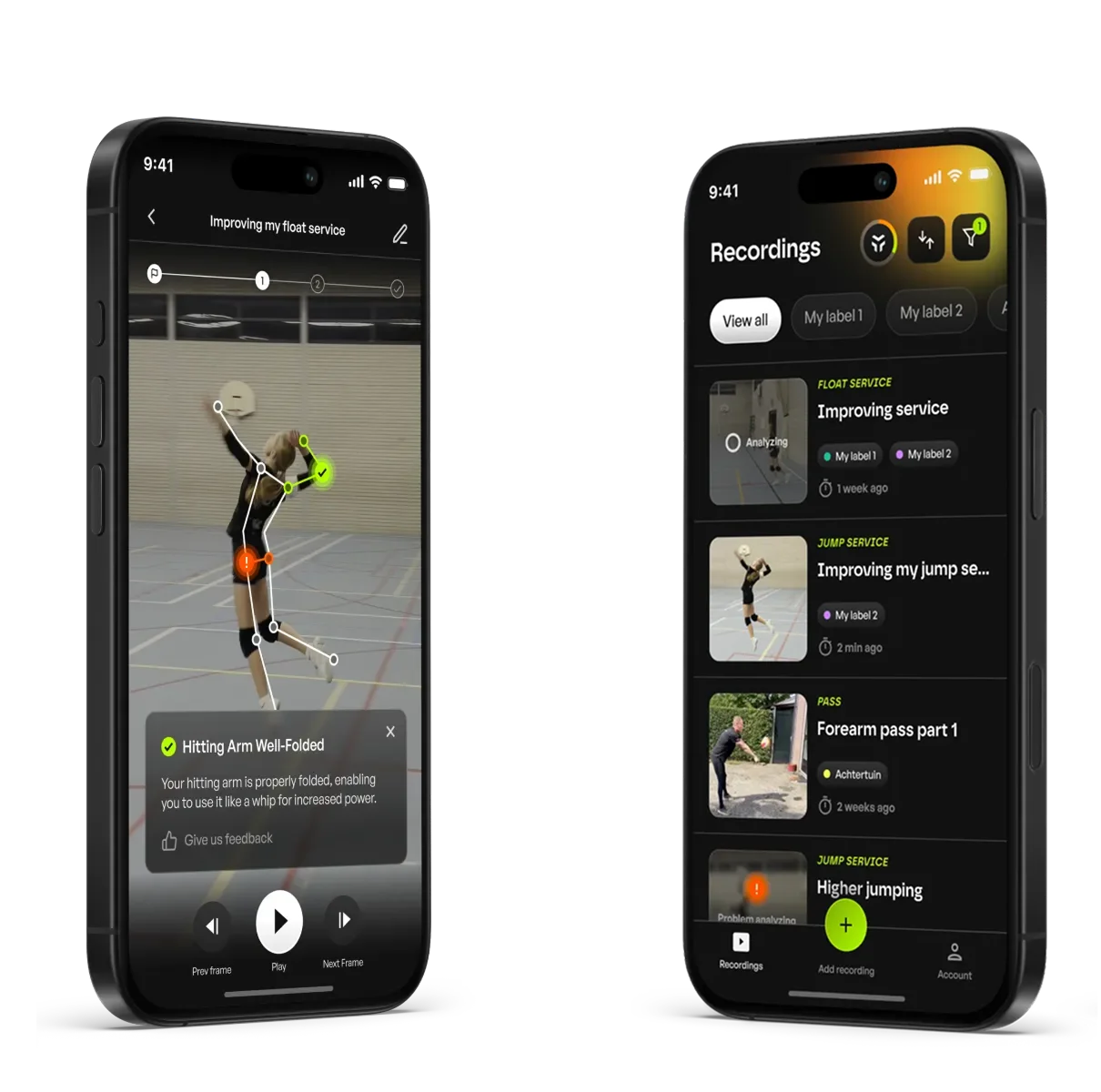
The analysis pipeline runs on a GPU server. When a video is uploaded, a pose detection model maps the player's body across every frame, tracking 133 keypoints from head to foot. In parallel, a custom object detection model locates the ball (whether yellow and blue, white, or beach-regulation red) even at the moment of contact, when motion blur is at its worst. The raw keypoint and ball position data is then passed to a rules engine, where a set of biomechanical conditions written by expert coaches determines which feedback to surface and what to say. For the jump serve alone, that rules engine contains more than 250 individual conditions, covering every phase of the movement from approach to follow-through.
The result is coaching feedback that is both visual, with frame markers showing exactly where a joint is misaligned, and textual, surfacing a specific, actionable correction. The entire process, from video upload to annotated result, runs in seconds.
The challenge of training on real-world sports footage
The obvious approach to AI sports coaching is pattern recognition: train a model on thousands of videos of correct technique and flag when a player deviates from the norm. Younalize evaluated this approach and ruled it out early, for a fundamental reason. The app's core users are recreational and developing players: athletes who are performing most techniques incorrectly, which is precisely why they are using the app. A pattern-matching model trained on professional footage has no stable reference point for a player who barely jumps, keeps their arm bent at contact, or has never learned to plant their feet before a serve.
The team also tried training sequence-detection models to identify technique phases automatically. The variability across skill levels was too high. A dataset spanning elite club players and first-time beginners produced too much noise for any single model to segment reliably.
Younalize's solution separates perception from coaching logic entirely. The AI handles what it does reliably: detecting and tracking bodies and objects in video. The coaching rules live in a separate layer, written by expert coaches and grounded in biomechanics rather than pattern matching. This architecture gives Younalize full control over the feedback the system surfaces, which an end-to-end ML approach cannot provide.
How Younalize uses CVAT Online
Younalize’s training data comes from footage that co-founder Matt van Wezel captures during coaching sessions, with player consent, across indoor courts, beach courts, and training facilities in the Netherlands, Norway, and India. The team has accumulated between 5,000 and 7,000 training videos spanning a wide range of playing levels, lighting conditions, and ball colors. None of this footage comes from the app's users: Younalize's privacy policy explicitly commits that uploaded videos are never used for model training.
The annotation pipeline is managed entirely through CVAT Online, and works in three stages:
- Frame extraction and local annotation. Python scripts run locally to extract frames from raw video clips, filter out unusable footage (poor angle, excessive motion blur, or frames where the player is out of frame), and run Younalize's custom YOLO and SAM 2 models to generate bounding boxes and pose labels. The complete pre-annotated batch is then uploaded to CVAT Online for verification.
- Verification in CVAT Online. Fabian reviews each batch of tasks in CVAT Online, accepting accurate pre-annotations and correcting misses, most commonly ball detections lost to motion blur or occlusion.
- Export, and retraining. Verified annotations are exported and combined with the corresponding frames to produce a new training dataset, which runs overnight on a dedicated GPU server. The next round of pre-annotations reflects the improved model.
The loop runs continuously alongside Fabian and Matt’s other responsibilities. A batch of four or five video clips typically takes less than half an hour to verify. By the following morning, a new model version is ready.
Why choose CVAT Online?
Younalize initially ran CVAT Community, the open-source edition, on Fabian's laptop via Docker. The setup worked for solo annotation, but collaboration with Matt van Wezel proved impossible: copying project directories between machines failed repeatedly, and the two founders ended up annotating independently without a shared dataset. Moving to CVAT Online resolved the problem immediately: both founders could access the same projects, tasks, and job queues from wherever they were working.
CVAT Online's API gives Younalize the flexibility to integrate their own custom models directly into the annotation pipeline as their workflow evolves. The team has used it to call their YOLO and SAM 2 models before frames reach the manual review stage, an approach that keeps human effort focused on the genuinely hard cases: motion-blurred ball detections, occluded keypoints, unusual playing conditions.
The combined result is measurable: dataset preparation that previously took weeks now takes days. For a two-person team without dedicated annotation staff, that compression is the difference between shipping model improvements continuously and batching them into infrequent labeling sprints.
1,300 users, 90 countries, no marketing budget
Younalize reached 1,300 active users across 90 countries without a paid marketing campaign. One national volleyball federation has already purchased 400 licenses for their pre-youth national training program. Another federation embeds Younalize in its annual coach development course. Each year, 100 to 150 trainers learn to run technique analyses on their players and design training plans from the feedback the app returns.
The app is also being used as a remote coaching tool. A Dutch head coach working with an African national beach volleyball team uses Younalize to monitor player technique during the months he spends back in the Netherlands. Players upload their own clips; the coach reviews AI-generated feedback remotely and builds individualized training plans from the results.
These use cases reflect the wider opportunity Younalize is pursuing. The International Volleyball Federation (FIVB) aims to grow the global volleyball movement from an estimated 800 million people today to 1.6 billion by 2032, according to its Strategic Vision 2032. The large majority of that growth will come from markets where professional coaching is unavailable or unaffordable. Younalize is in active conversations with the federation about embedding the app in their Volleyball Empowerment program, which places elite coaches in underserved markets to develop the sport from the ground up.
The annotation workflow built on CVAT Online is already supporting this expansion. Field hockey is in active development, requiring new detection models for both the ball and the hockey stick. No reliable pre-trained models existed for either, so Younalize built them from scratch using the same pipeline. A strength and conditioning module is in progress for athletes in national training programs. Each new sport or technique follows the same path: collect footage, annotate in CVAT Online, train, iterate.
Making expert coaching accessible at scale
Younalize is building the infrastructure to make expert sports coaching as accessible as a smartphone. The annotation pipeline that powers the AI, running on CVAT Online and driven by custom pre-annotation models managed by two founders, is what allows the product to improve continuously without a dedicated data team.
CVAT Online provides the cloud access that makes collaboration possible, the API flexibility that lets Younalize's own models do the pre-annotation work, and the annotation environment where human judgment is applied only where it is genuinely needed. As Younalize scales across new techniques, new sports, and new markets, the same workflow scales with it.

Explore CVAT Online for cloud-based annotation, CVAT Enterprise for self-hosted deployments, or our Labeling Services for fully managed annotation.





Get Started Today


.svg)
.png)

.png)







.png)