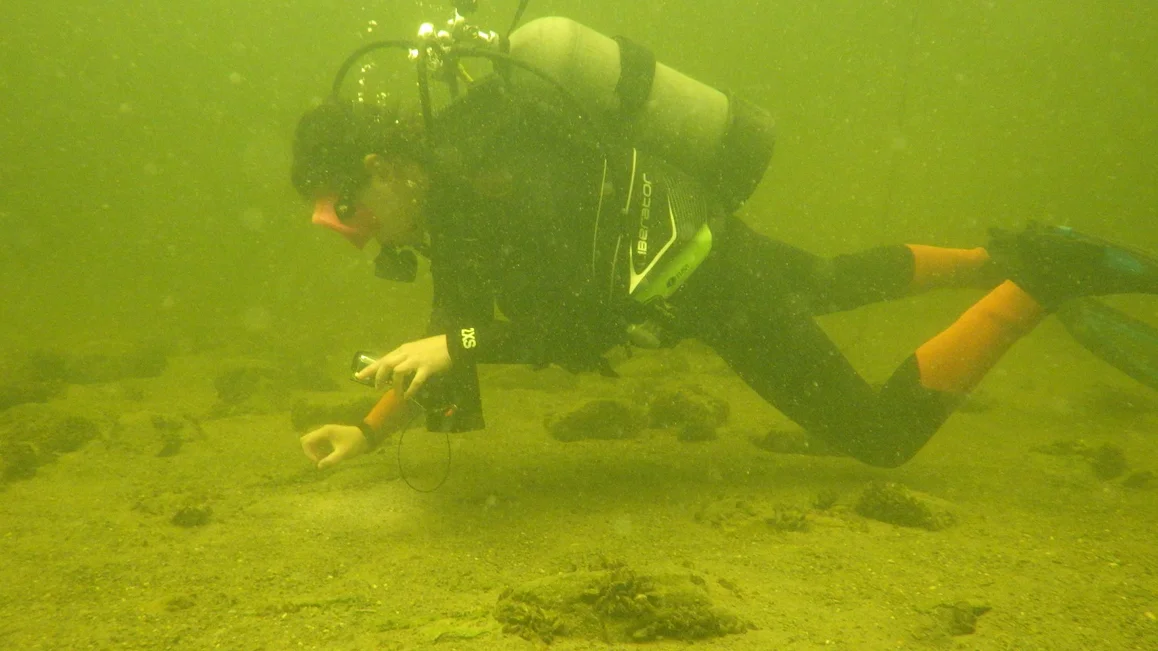
The lake that wasn’t supposed to have themIn late 2022, Véronica Romero-Rosales and her partner David were visiting his parents at Lake Témiscouata, a long, cold lake in eastern Quebec. Over dinner they heard the news: zebra mussels — an invasive species most people associate with warmer waters like the Great Lakes — had turned up in a place no one expected.Lake Témiscouata, eastern Quebec — one of two recently invaded lakes Robonotic sampled to build its dataset.Véronica and David are both engineers, and both have a background in robotics and AI. The conversation kept circling the same question: if everyone knows the damage zebra mussels can do, why is nobody doing anything about it?“We were just thinking at the end of the day, how come nothing is being done? What can we do as citizens for the long term? That’s when we came up with the idea — the technology already exists. So it would be nice to create a solution that helps people monitor what’s going on underwater.”Véronica Romero-Rosales, Co-founder, RobonoticThe damage is not hypothetical. Forty years after infesting the Great Lakes, zebra mussels have thinned fish populations (that out-filter the zooplankton juveniles depend on), clogged municipal water pipes, and left beaches lined with razor-sharp dead shells. Véronica cites a small Canadian city (30,000 citizens) that just earmarked $1.2 million for a single year to keep its water intakes mussel-free.But that damage takes decades to compound. Catching an invasion early, when mussels are still hiding in isolated clusters, before the lakebed turns into a reef of shells, is the whole game. It is also the hardest moment to monitor, because there is almost nothing to see.Two engineers, one missionThe couple became Robonotic. Véronica took the CEO role; David took on hardware. But the project needed something neither engineer had at the start: a deep understanding of freshwater ecology.So Véronica went back to school. She enrolled in a master’s in oceanography under a professor who specializes in mollusks, pairing the biology with the AI. Along the way, Robonotic connected with two other organizations that became central to the project: the Quebec Artificial Intelligence Institute (Mila) and DeepSense, based in the Faculty of Computer Science at Dalhousie University. Mila helped the team think through model ethics and data strategy, while DeepSense matched the company with project managers and interns to help them develop their AI solution. “As engineers, we can do a lot of good things, but we can also do a lot of bad things when we don’t know the big picture. The biology part is very important. If we’re not careful enough, we can do more damage than good.”Véronica Romero-Rosales, Co-founder, RobonoticThat cautious posture shaped everything that came after — the partnerships, the data pipeline, the model, and the product roadmap.Learning to see underwaterRobonotic’s first break came from Bleu Massawippi, a Quebec association that has been fighting aquatic invasive species for more than six decades. Its general director, Laurence Renaud-Langevin, took the team under her wing; her divers became Robonotic’s first data-collection crew.But Véronica didn’t want to stay on the shore. “As a leader, you have to know exactly what are the efforts needed to get some data.” So she got her dive certification — which was harder than it sounds.Véronica on a data-collection dive in Lake Témiscouata.“I’m scared of the water, and I’m scared of small, confined places,” she says. “The tank is heavy and I’m small — five-foot-one.” Her first underwater attempts ended in anxiety; a patient instructor walked her through it step by step. Véronica now dives in Quebec summers — and the experience has reshaped how Robonotic scopes its own projects.“I have a really clear idea now of how many hours you have to plan ahead just to get one hour of footage,” she says. That clarity ends up mattering for every future commercial bid.A dataset built one frame at a timeRobonotic’s dataset comes from three deliberate sources.First, two recently invaded lakes — Lake Massawippi and Lake Témiscouata — rather than well-documented lakes already carpeted in mussel clusters. Robonotic specifically wanted footage of the hard cases: mussels hiding under rocks, small solitary ones, early colonies. A model trained only on dense clusters would be useless for the work the team actually wants to do.Second, a deliberate mix of cameras — GoPros for what a typical diver would carry in the field, plus an intermediate camera and two professional rigs for capturing the fine characteristics of juveniles and getting quality pictures even with turbidity for annotation. The variety means the model learns to recognize mussels regardless of the device the client happens to have on hand.One of Robonotic’s action-camera rigs: GoPro, dual LED lights, mounted on a dive-ready tray.Third, an improvised studio at an aquaculture station, where Véronica held roughly 200 live zebra mussels for six months. An aquarium, two underwater LED lights, a camera on a tripod — she shot thousands of controlled reference frames from every angle.Robonotic’s improvised photo studio at an aquaculture station: aquarium, underwater LED light, and a tripod-mounted camera.The reason for the variety: zebra mussels don’t look alike. “They all have different patterns in their shells. You might take a look at one and say, well, this doesn’t look like a zebra mussel — but it is one. The colors vary: blue, white, gray, all on the same lake.” A model trained only on textbook specimens would miss half of them in the wild.All told: roughly 52,000 frames, of which about 9,300 (~15%) are annotated and powering the current model. The team applies augmentation — blur, crops, rotations, color shifts — so the detector learns to cope with real-world underwater conditions: silt, low light, and motion blur.Why CVAT won outBefore landing on CVAT, Véronica evaluated three other tools. None of them was built for the way Robonotic actually works: multiple annotators, a central reviewer, a correction loop, and a project lead whose job is to keep everyone’s definition of “this is a zebra mussel” identical.“There wasn’t anything for working as a team,” she says of the alternatives. CVAT came up twice in parallel — once from her advisor at Mila, a Montreal-based artificial intelligence research institute, and again from the collaborating Dalhousie University team. She gave the CVAT Online Team plan a try and it stuck.“It was user-friendly and easy to learn. And since I knew I was going to be working with friends and colleagues who wanted to help out because they liked the project, I was looking for something easy to work with.”Véronica Romero-Rosales, Co-founder, RobonoticInside the annotation workflowVéronica runs annotation the way she used to run quality control in her previous engineering roles: tight SOPs, dummy-proof steps, and a real training ramp for every new annotator.Every volunteer, student, or friend who comes in reads the written work process first, then spends 30–60 minutes in a live training session before being assigned their first job. Inside CVAT, jobs move through explicit stages: annotation → verification → validation → done. Véronica uses verification herself to leave notes on individual bounding boxes (“tighten this box,” “wrong attribute,” “you missed one here”) and pushes jobs back for rework until they’re training-ready.Robonotic’s project in CVAT Online, with per-label annotation of zebra mussels and native freshwater mussels (“Mulette”).“We’re engineers — and I’ve worked in quality control before. Because we’re humans, we need dummy-proof processes just to have the same result every time. The stage and state workflow in CVAT is really helpful: I put notes, I send it back, and whenever a job is ready for training, we just switch the stage.”Véronica Romero-Rosales, Co-founder, RobonoticCompleted annotations export in YOLO format and feed training runs on AWS SageMaker, with experiments also running on an NVIDIA Jetson Orin — the same class of hardware Robonotic wants to eventually carry into the field for real-time, on-device detection.The team has also experimented with CVAT’s built-in SAM-based auto-labeling. It didn’t meaningfully accelerate their work yet — zebra mussels are small, textured objects that often blend into rocks, and Robonotic’s dataset is still small by foundation-model standards — but Véronica plans to try CVAT’s newer text-prompt segmentation and, down the road, bootstrap new annotations from Robonotic’s own fine-tuned model.“Someday I definitely want to use all the integrations,” she says. “The way we’ve been working wasn’t the most effective — but for the beginning, it was the right thing for us.”What kept them on CVATA lot of annotation tools could get the bounding boxes drawn. What kept Robonotic on CVAT, Véronica says, isn’t features — it’s support.“The reason I chose to stay with CVAT is because when I had issues, I got a quick answer from the support team. Nobody has time to lose. When you have to contact support at a larger tech company, it is hard to get an answer — but with CVAT, it’s easy and doesn’t take too much time. I felt there was a team behind the tool who was listening to the customer’s needs — willing to work with me, not just sell me something. The tool is great and user-friendly. But the support team behind it is what made the difference.”Véronica Romero-Rosales, Co-founder, RobonoticThat partnership cuts both ways. Because CVAT.ai also offers a managed labeling service to customers who need it, the same team working on the product is doing annotation projects themselves — and carrying those insights back into the tool.What’s next for RobonoticRobonotic is finishing its prototype phase and starting customer discovery in earnest. On the near-term list:The Quebec Ministry of the Environment, which has flagged roughly five lakes with environmental-DNA hits for zebra mussels that now need visual confirmation — the exact job Robonotic’s model is designed for.Continued work with Bleu Massawippi, Robonotic’s founding partner, whose monitoring program is where this story started.A presentation circuit — Montreal in May, El Salvador in October — aimed at aquaculture and freshwater-research communities. Véronica also speaks Spanish, and sees Latin America as a natural expansion market for the same technology pointed at different invasive species.“Our goal is to bring this kind of technology to normal biologists — people who don’t have the tools we have in other fields. To bring it into something that is very urgent for us to take care of.”Véronica Romero-Rosales, Co-founder, RobonoticNative freshwater mussels (“mulettes”) Robonotic is also learning to identify — species biologists want to protect, not remove.Robonotic’s current model already detects zebra mussels, invasive snails, and crayfish out of the same two-lake dataset. As the team takes on new waters and new clients, that list will grow. And as new jobs move through CVAT’s pipeline, the model gets sharper with them.
Robonotic goes from zero data to a working invasive species detector with CVAT Online


.svg)
.png)

.png)


