


FERNRIDE accelerates perception model training with CVAT Online's new 3D annotation tools

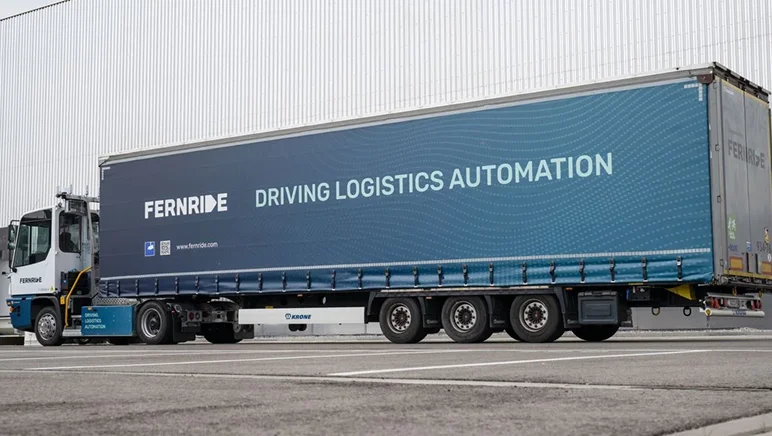

FERNRIDE is a Munich-based deep-tech company specializing in autonomous, electric trucking solutions, particularly for logistics. It was spun out of the Technical University of Munich (TUM) in 2019 and focuses on "human-assisted autonomy," a hybrid approach where autonomous driving is combined with teleoperation, allowing human operators to remotely control trucks when needed while AI handles routine driving tasks.

FERNRIDE's LiDAR annotation workflow required 3D cuboid labeling capabilities - precise rotation control, exact size input, and orientation indicators - that CVAT did not yet support.
CVAT Online developed three targeted 3D cuboid labeling features for FERNRIDE's use case and shipped them to production in five weeks.
FERNRIDE's annotation accuracy improved significantly, labeling workflows accelerated by 30%, and point cloud data quality directly strengthened their autonomous trucking perception models.
When autonomous trucking runs into point cloud annotation limits
To turn conventional electric trucks into reliable autonomous assets [that can perceive their surroundings, make driving decisions, and execute transport tasks], FERNRIDE developed a platform that combines AI with cameras, sensors, and advanced software. Mounted on top of a vehicle, these systems not only enable real-time autonomy but also collect valuable visual data of what the trucks “see” during their rides.
This data, in the form of point clouds and videos, is then labeled and fed back into the platform to continuously improve the vehicles’ perception, navigation, and decision-making capabilities on the road.
However, labeling such data, especially 3D point clouds from LiDAR, is notoriously complex. While video annotation is relatively well-supported by many tools, 3D data introduces a steep learning curve and demands precise functionality to ensure annotation accuracy, especially for data captured in full-surround industrial settings.
While FERNRIDE found CVAT’s 3D features promising in early tests, scaling up to larger and more complex datasets revealed several usability and workflow challenges:
- Limited precision when rotating cuboids: Adjusting object orientation was difficult due to fixed rotation angle, making it hard for annotators to align cuboids accurately in point cloud scenes.
- Inconsistent cuboid labeling: Adjusting cuboid shapes and correcting errors took too many steps, leading to annotation inconsistency.
- Limited support for object relationships and visibility: Understanding spatial relationships (e.g., cargo stacked on pallets, vehicles crossing paths) was difficult without more advanced visual cues and orientation tools.
These limitations hindered the team's progress in labeling and training AI models.
Custom 3D labeling features, purpose-built for production
Recognizing the limitations, the CVAT team stepped in to address them right away. For every issue the customer surfaced, CVAT allocated dedicated engineering resources to ensure timely, targeted updates aligned closely with FERNRIDE’s expectations.
As a result, within just 5 weeks, the CVAT team released three major feature updates specifically designed for more precise and intuitive point cloud labeling.
1. Smooth Cuboid Rotation for Accurate Point-Cloud and Label Alignment
FERNRIDE's first bottleneck was adjusting the orientation of 3D cuboids when labeling objects in LiDAR scenes. The fixed rotation speed in CVAT’s 3D workspace made it difficult to fine-tune angles, particularly when annotating objects that required precise alignment, such as cargo containers or vehicles in tight spaces. This, in turn, slowed down the annotation process, and the labeling quality.
To address this, CVAT introduced dynamic 3D cuboid rotation that adapts to the annotator’s mouse movement. Now, faster mouse movement results in a larger rotation angle, allowing for quick adjustments. Slower movement yields finer control, allowing annotators to focus on details without overshooting.
2. Precise Cuboid Size Input Controls for Centimeter-Level Precision
The second update addressed the size of the cuboids used to label objects in 3D scenes. FERNRIDE's machine learning team required precise annotations down to the centimeter in order to train systems to reliably handle cargo containers, pallets, and barriers. Without this level of precision, annotators had to "eyeball" object dimensions, which resulted in inaccurate and inconsistent annotations, and inaccurate perception by their AI vision models.
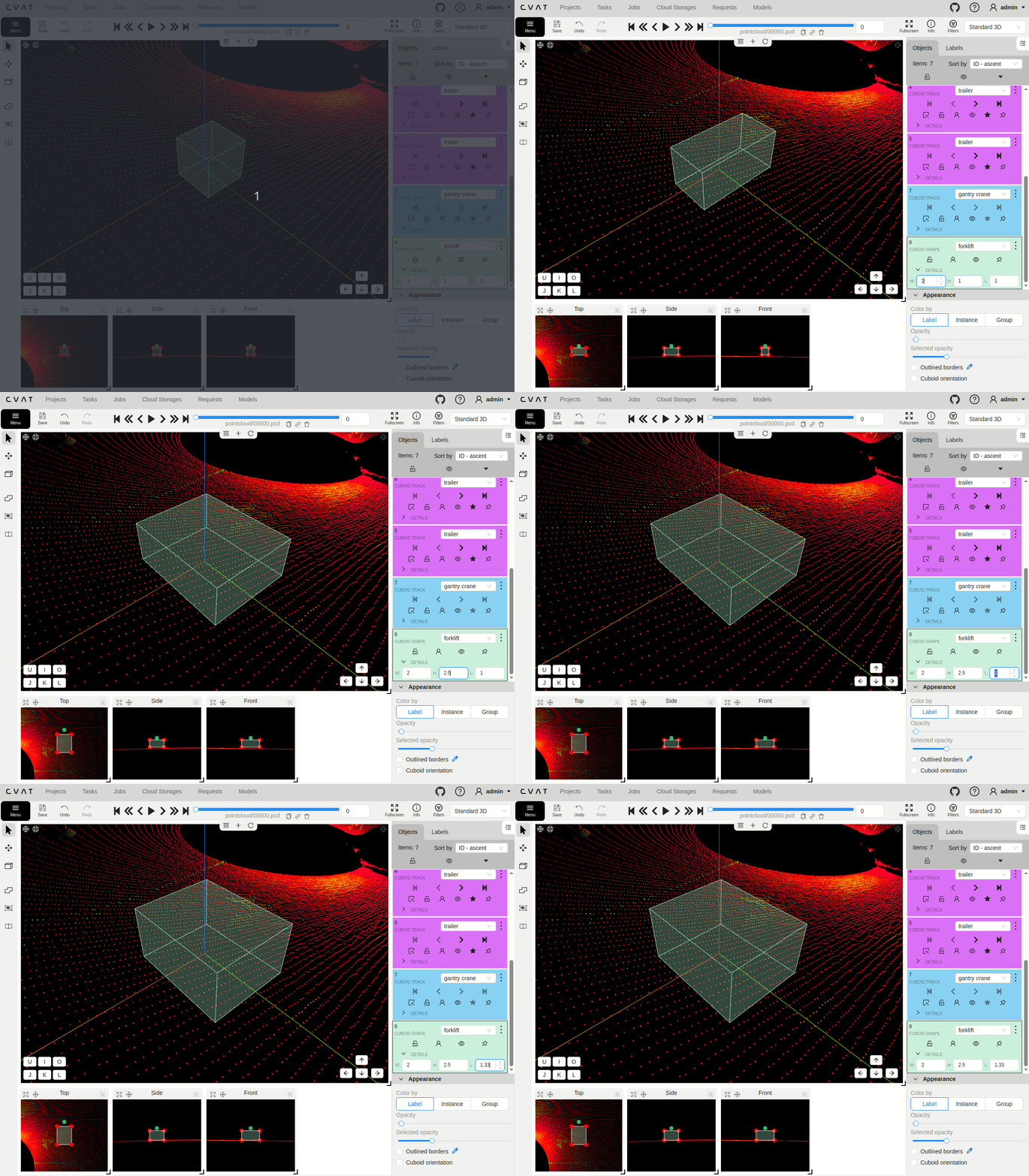
To solve this problem, CVAT introduced manual cuboid input fields that gave annotators full control over the exact height, width, and depth measurements of each 3D object. Since container dimensions are typically standardized and known in advance, this feature allowed annotators to label identical containers consistently across multiple scans instead of estimating their size visually. As a result, labeling became both faster and more reliable, improving data quality and model performance for tasks requiring high spatial accuracy.
3. Cuboid Orientation Arrows for Directional Accuracy
The final, yet important update was related to object orientation in LiDAR scenes. In container terminals and logistics environments, misjudging the direction of trucks, cargo, or barriers can lead to significant risks both in model training and in real-world deployment.
FERNRIDE’s annotation team struggled to consistently align cuboids with the true facing direction of objects in a point cloud environment. Without a clear directional indicator, some cuboids were rotated incorrectly introducing noise into the dataset and affecting motion tracking models downstream.
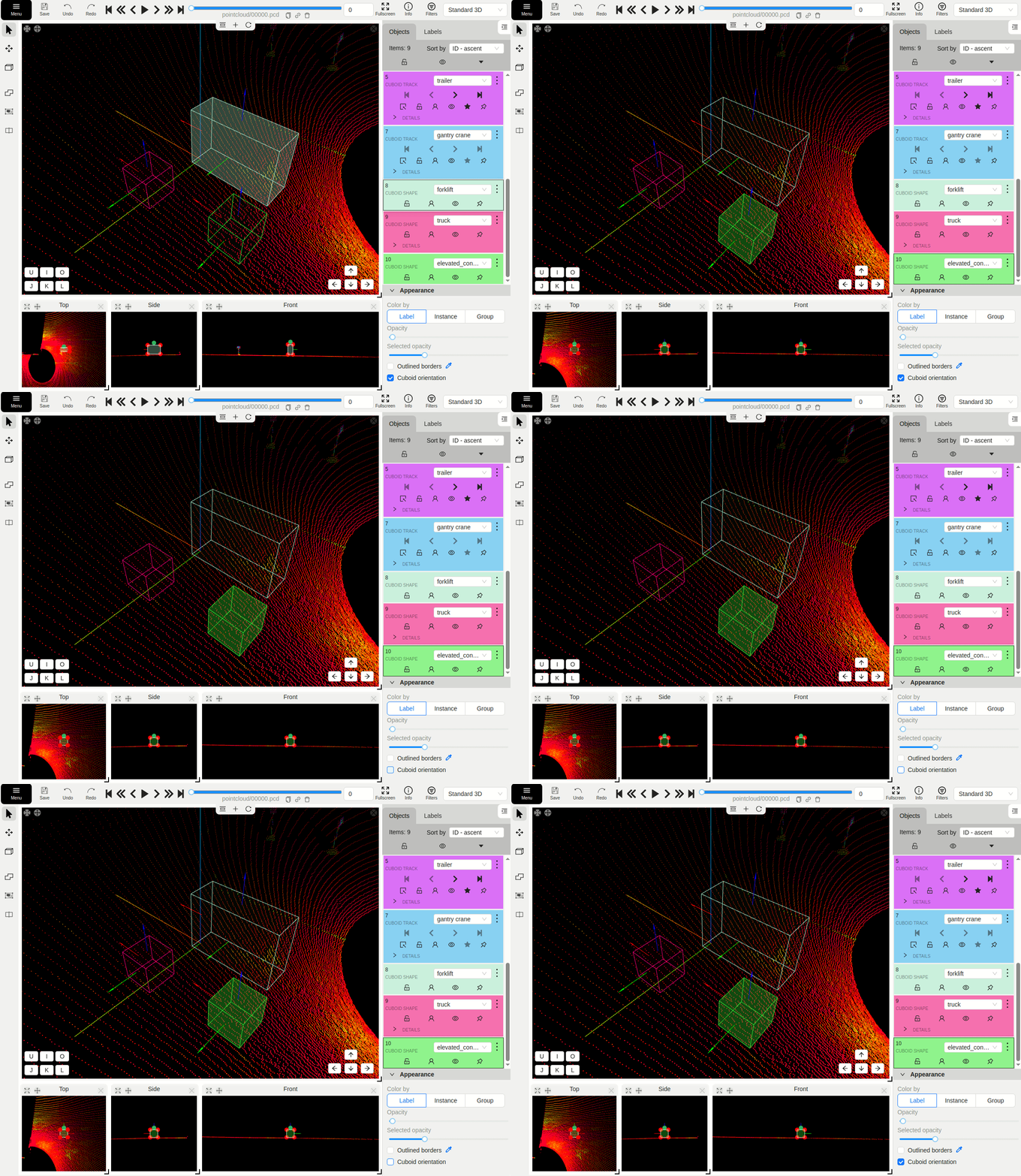
To overcome this, CVAT introduced orientation arrows that allow annotators to quickly and accurately set the direction of labeled objects. These arrows dynamically represent the cuboid’s orientation along the X, Y, and Z axes across all views, including Perspective, Top, Side, and Front. They are scalable based on cuboid size, configurable to suit annotation needs, and can be toggled on or off for a cleaner workspace.
Better tools, cleaner data, stronger perception models
The impact of CVAT’s 3D enhancements, shaped directly by FERNRIDE’s feedback, was felt across every stage of the client’s labeling workflow. With the ability to precisely control cuboid dimensions, accurately set object orientation, and adjust cuboid positions more smoothly within dense point clouds, FERNRIDE unlocked several key benefits:
1. Greater annotation accuracy
Centimeter-level control over cuboid size and orientation significantly reduced labeling errors, resulting in cleaner datasets and more reliable training inputs for their perception models.
2. Faster labeling workflows
Enhanced 3D controls and smoother cuboid manipulation allowed annotators to adjust object dimensions and orientations more intuitively in dense point cloud scenes. This streamlined the labeling process, accelerating project delivery timelines by 30% and reducing time-to-deployment for FERNRIDE’s perception models.
3. Stronger AI models and broader applications
Higher-quality point cloud annotations directly improved the performance of FERNRIDE’s AI models, enabling more accurate motion tracking, better scene understanding, and safer autonomous vehicle behavior in real-world logistics environments.
Going forward, insights from FERNRIDE’s use cases will continue to shape CVAT’s roadmap for scalable, high-precision 3D labeling.
“Working with FERNRIDE showed how deep collaboration with customers can directly shape the evolution of our platform. The 3D features we built together are already making annotation easier and more precise for other teams tackling complex, high-stakes use cases in autonomous driving, robotics, and industrial automation.”
Nikita Manovich,
CEO of CVAT

Explore CVAT Online for cloud-based annotation, CVAT Enterprise for self-hosted deployments, or our Labeling Services for fully managed annotation.






Get Started Today


.svg)
.png)

.png)







.png)