


Welcome to the August edition of the CVAT Digest.
This month, we shipped two releases, v2.73.0 and v2.74.0, with updates across annotation quality control, mask editing, cloud storage, webhooks, dataset import, and developer workflows, including:
- Configurable quality requirements for tasks and projects
- A new option to outsource data labeling
- Local undo and redo for mask editing
- S3-compatible backing storage for video tasks
- More useful webhook events and payloads
- Improved layer visibility controls, and more
What’s new
More flexible quality requirements
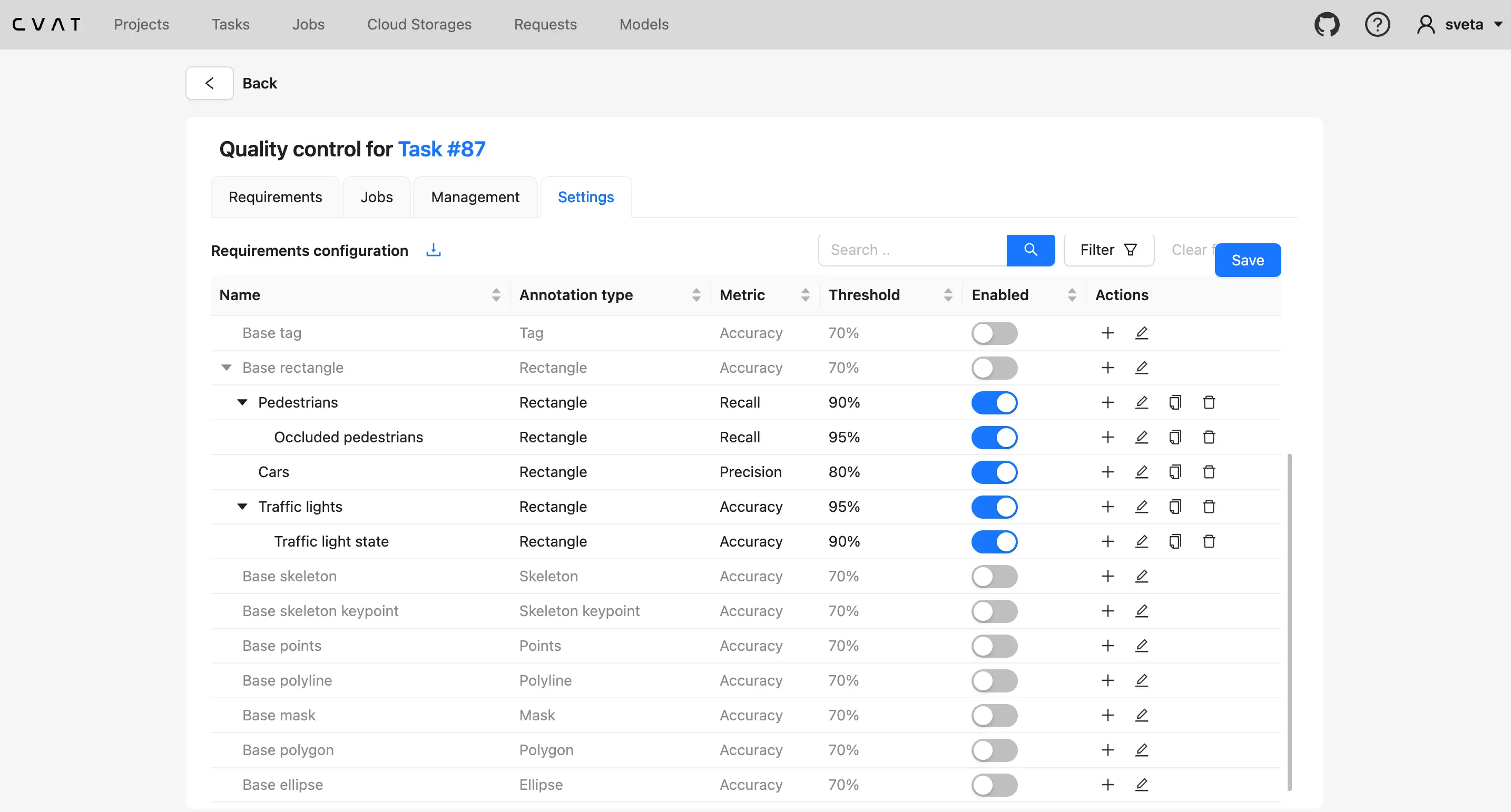
In v2.74.0, we added configurable, hierarchical quality requirements for tasks and projects.
Quality requirements let teams define more specific rules for evaluating annotation quality. A requirement can apply to a selected subset of annotations, inherit comparison settings, define metric thresholds, and include rules for comparing annotation attributes.
For example, a project can use general quality requirements across the entire dataset while applying stricter thresholds to selected labels, attributes, or other filtered subsets.
Quality reports now show results for each requirement separately and provide downloadable confusion matrices for deeper analysis. This gives project managers and reviewers a more detailed view of where annotations meet expectations and where additional review may be needed.
The new requirements can be configured directly in the CVAT interface.
Learn more: Get Actionable Insights into Your Dataset’s Annotation Quality with Quality Requirements
Outsource your data labeling directly from CVAT
As datasets grow, internal annotation teams may not always have enough capacity to keep up. A large project, a sudden increase in data volume, or a tight deadline can create a labeling backlog even when an established annotation workflow is already in place.
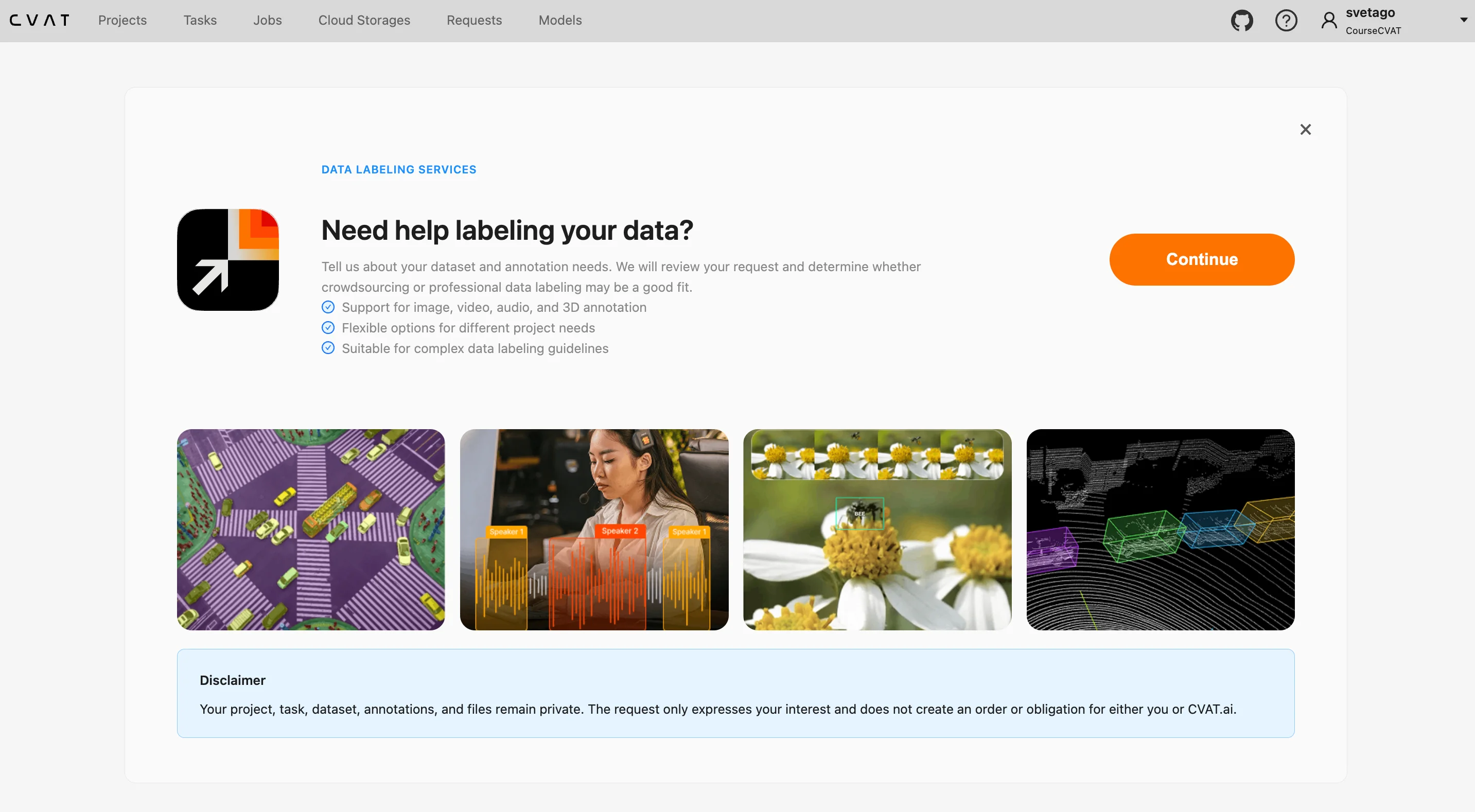
That's why, CVAT now provides an option to request additional labeling capacity directly from the platform.
Depending on your project’s scope, complexity, timeline, and budget, you can choose between two outsourcing models:
- Professional data labeling — have your data labeled by the CVAT Labeling Services team. Best suited to complex, sensitive, or expertise-intensive projects that require dedicated coordination, evolving instructions, NDAs, or custom data handling.
- Crowdsourcing data labeling — have your data labeled by third-party annotators through a crowdsourcing platform. Best suited to clearly defined, repeatable tasks that need to scale across multiple contributors.
Select the model that fits your project and submit your interest to CVAT.ai to discuss your dataset, annotation requirements, scale, security considerations, and next steps.
Learn more about CVAT Labeling Services
Local undo and redo for mask editing
In v2.73.0, we added local undo and redo for mask drawing and editing. You can now undo or restore individual brush, eraser, and polygon actions while working on a mask. This makes it easier to correct a misplaced stroke or polygon point without discarding the entire mask or reverting unrelated annotation changes.
We also added outlines to interactor mask previews, making mask boundaries easier to distinguish before applying the result.
S3-compatible backing storage for video tasks
Video tasks can now use S3-compatible cloud storage as backing storage.
Backing storage allows CVAT to keep task media in connected cloud storage instead of storing another copy in the local CVAT deployment. Extending this workflow to video tasks gives teams more flexibility when working with large video datasets or cloud-first data pipelines. The update applies to S3-like storage services, including providers that expose an S3-compatible API.
We also fixed an issue that could prevent task creation when a video and its manifest were stored in a selected cloud storage directory or referenced through a filename pattern.
More useful webhooks for automated workflows
In v2.73.0, we expanded webhook support for asynchronous requests. External systems can now receive webhook events for operations that CVAT processes in the background. Update webhook payloads also include a new changes field, which describes what changed in the updated resource.
This gives integrations more context and can reduce the need to fetch and compare the full resource after every event.
We also reorganized the response from GET /api/webhooks/events. The endpoint now returns structured objects containing an event key and a display name for its group, instead of returning only a list of event key strings.
As part of this update, the previous create:export and create:backup events were renamed to request-completion events for dataset, annotation, and backup exports. Existing integrations that depend on the previous event names should be updated.
More practical layer visibility controls
We updated how annotation layer visibility is managed on the canvas. Instead of filtering the view to a single active layer, each layer now has its own visibility control. All layers are visible by default, and you can show or hide them individually.
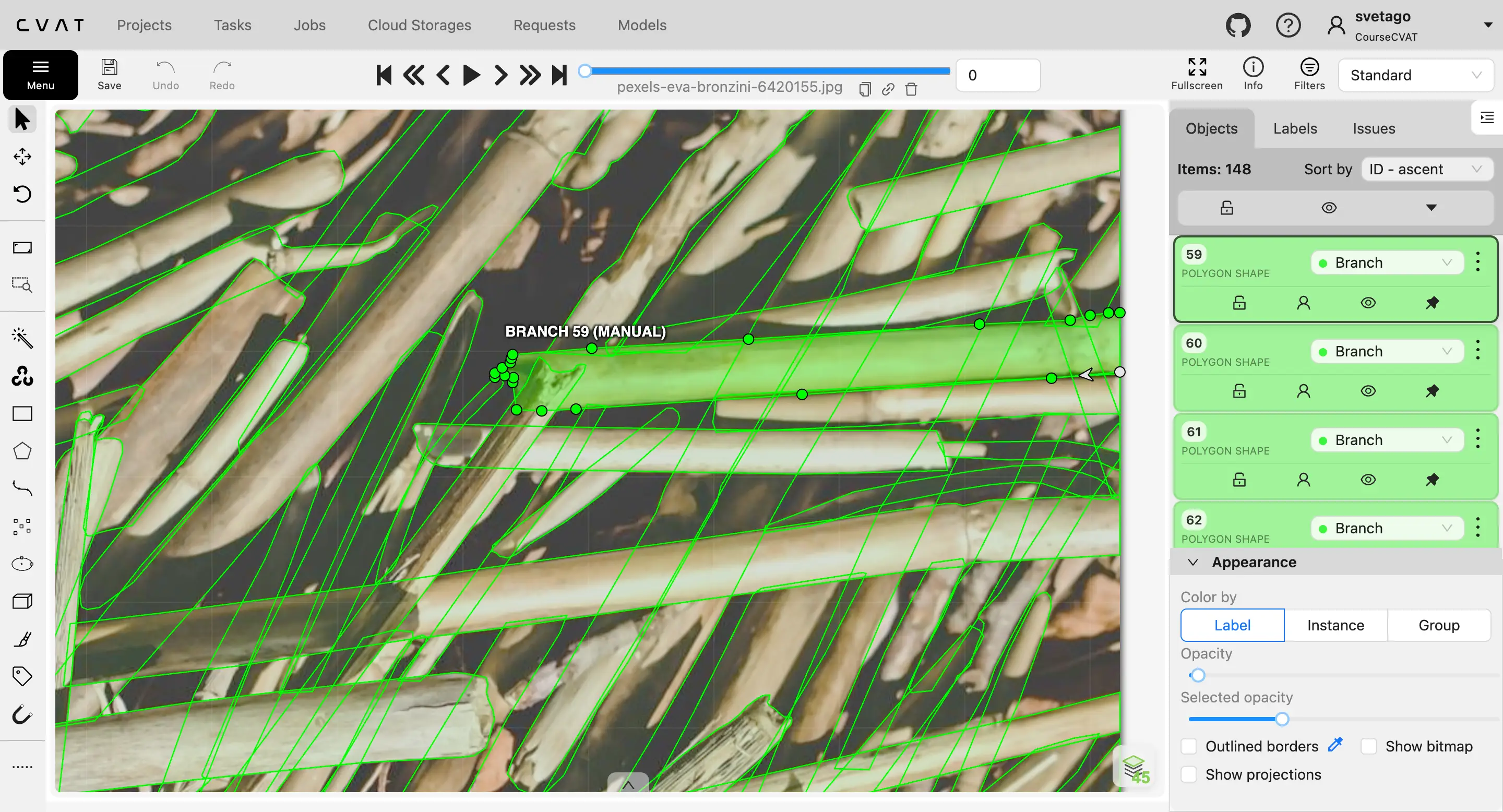
Shift-clicking a layer visibility button toggles that layer together with the layers below it in the visual stack. This is useful when reviewing overlapping annotations or isolating selected parts of a dense scene.
The update builds on the layer management tools introduced earlier this year and gives annotators more direct control over what appears on the canvas.
Annotation and interface improvements
August also included several smaller improvements across annotation and resource-management workflows.
Custom shortcuts for switching labels are now preserved after reloading the page. We fixed undo and redo behavior for skeleton point state changes, so updating the outside state no longer changes the point’s occlusion state unexpectedly.
The raw label editor now accepts numerical attributes when the minimum, maximum, and step values are valid but not all different. We also improved the editor’s saving and reset states and made the label type dropdown wide enough to display complete option names.
Long label-mapping lists in the model runner dialog can now be scrolled, while filtered resource lists preserve their pagination state more reliably when users return through browser navigation.
Reliability improvements
The August releases included fixes for several issues affecting task creation, annotation data, user accounts, and cloud-backed projects.
These include:
- Fixed unexpected task creation failures that returned a Task.DoesNotExist error.
- Fixed duplicate accounts that could be created from invitation email addresses with different letter casing.
- Fixed persistent 429 Too Many Requests errors when retrieving chunks from jobs with partially updated honeypots.
- Fixed corrupted annotation chunks after interrupted or resumed downloads.
- Reduced excessive memory usage when deleting projects containing many tasks backed by cloud storage.
- Improved pagination behavior when returning to filtered resource lists.
- Fixed shortcut customizations being reset after a page reload.
CVAT now also uses its own user model instead of Django’s default model. Existing users, permissions, and data remain unchanged.
CLI, SDK, and API updates
The CLI now supports a --file option for cvat-cli profile create. This allows a Personal Access Token to be read from a plain-text file or supported JSON envelope, making it easier to configure profiles in scripts and automated environments.
We also added a new set of practical CVAT SDK examples under cvat-sdk/examples/.
Additional Server API updates include the new quality-requirement data model, structured webhook event responses, and stricter validation for attribute names in lambda function label mappings.
Teams using the quality settings or webhook APIs should review the release notes for the related response and event-format changes before upgrading integrations.
Other technical updates
August releases also included additional annotation, API, cloud-storage, and infrastructure fixes.
For the complete technical list, see the release notes for v2.73.0 and v2.74.0.




.svg)
.png)

.png)







.png)