


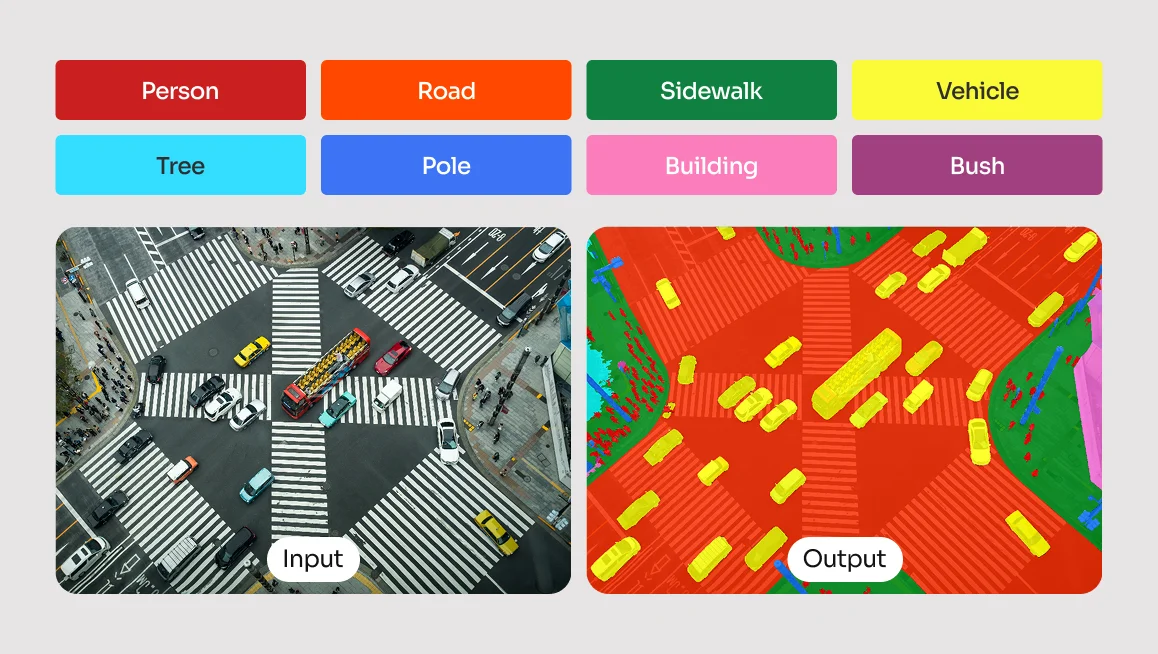
Semantic segmentation is one of the three foundational computer vision tasks that labels every pixel in an image with a category, such as "road," "pedestrian," "sky," or "vehicle."
Instead of drawing a loose box around an object, the model produces a precise, pixel-level map of the entire scene, known as a segmentation mask.
The semantic part of the name is crucial because it means the model cares about the meaning or category of each pixel, but it does not separate individual instances of the same category (which is the separate instance segmentation task).
So if two pedestrians are standing next to each other, semantic segmentation labels all of their pixels as "pedestrian," effectively merging them into a single region of that class.
This is what makes it powerful for understanding scenes at a glance, and it is also what sets it apart from related techniques like instance segmentation, which we'll cover next.
Semantic Segmentation Is One of Two Types of Segmentation
Before diving into how semantic segmentation works, it is important to understand where it sits within the broader discipline of image segmentation, which is often divided into semantic and instance segmentation.
Semantic Segmentation: Every Pixel Gets a Class, But Objects Are Not Separated
In semantic segmentation, every pixel in an image is assigned a class label, such as "road," "sky," or "vehicle." However, no distinction is made between separate objects of the same class.
If there are three cars in an image, all of their pixels are simply labeled "car," merging them into a single continuous segment.
This approach is best suited for continuous or uncountable regions, often referred to as "stuff," where the exact number of objects is less important than the total area they occupy. Common examples include sky, road, water, and vegetation.
Instance Segmentation: Same Class, Different Objects, So Each One Labeled Individually
Instance segmentation separates individual objects of the same class. If there are three cars in an image, they are labeled individually as Car 1, Car 2, and Car 3.
This method focuses entirely on countable objects, often referred to as "things" (such as people, vehicles, or animals), and typically ignores background pixels. It is the right choice when your model needs to count, track, or reason about individual objects rather than regions.
For most teams, the choice between these three comes down to what the model needs to do. For example:
- Segmenting a drivable road surface calls for semantic segmentation.
- Counting and tracking individual pedestrians calls for instance segmentation.
Quick Comparison
Where Is Semantic Segmentation Used?
Semantic segmentation is a critical component of some of the most advanced AI systems operating today, and the practical stakes of getting it right are enormous across several major industries.
Autonomous Driving
In the autonomous vehicle industry, semantic segmentation is essential for safe navigation. The global AI in computer vision market is projected to reach $63.48 billion by 2030, driven heavily by autonomous systems.
Self-driving cars use semantic segmentation to instantly classify drivable roads, sidewalks, pedestrians, and obstacles in real time. The entire pipeline depends on high-quality annotated data to make split-second decisions. Even a few mislabeled pixels can have life-critical consequences.
Medical Imaging
Semantic segmentation is reshaping healthcare diagnostics. The AI in medical imaging market is projected to reach $20.2 billion by 2033, growing at a compound annual rate of 35.11%.
In this field, segmentation models enable the precise delineation of tumors, organs, and tissue types in MRI, CT, and X-ray images. The U-Net architecture was born from this exact challenge, and its descendants now power clinical tools that assist radiologists in identifying pathologies that might otherwise be missed.
CVAT's annotation services support medical imaging workflows, including anatomical structure segmentation and tumor detection for diagnostics and research.
Satellite and Aerial Imagery
In agriculture and geospatial analysis, semantic segmentation is applied to high-resolution satellite and drone imagery. It powers a wide range of applications, including:
- Land cover classification for urban planning and environmental monitoring
- Crop health monitoring and yield estimation from drone footage
- Urban growth analysis and infrastructure mapping
- Post-disaster damage assessment for emergency response
As AI continues to reshape agriculture, robust data annotation for aerial imagery is becoming increasingly vital. The ability to segment crops from weeds, or healthy vegetation from diseased patches, at scale from drone footage is transforming how farms are managed.
Retail and Manufacturing
In the retail and manufacturing sectors, semantic segmentation powers automated background removal, virtual try-ons for e-commerce, and defect detection on production lines. By segmenting products or components at the pixel level, automated quality control systems can identify microscopic flaws faster and more reliably than human inspectors.
This is one of the fastest-growing application areas, as manufacturers seek to reduce waste and improve throughput without adding headcount.
How Does Semantic Image Segmentation Work?
Modern semantic segmentation is powered by deep learning. Rather than following the hand-tuned rules of older image processing, the model learns to label pixels by studying examples that people have already labeled by hand.
During training, the model learns to predict labels for the human-annotated images provided in the dataset and tries to generalize its knowledge to work for the images the model has never seen. Everything the model knows about where a road ends and a sidewalk begins, it learned from how your annotators drew that boundary.
That dependence is also why labeling is rarely a one-and-done step. Labels often have to be revisited and redone during model development for a few common reasons:
- Errors and inconsistencies surface during training. If two annotators handled the same situation differently, the model receives two data points that contradict each other. As a result, the model is unable to produce the correct answer. Fixing that confusion usually means correcting the labels, not the model.
- Edge cases force the taxonomy to evolve. Production data surfaces situations the original guidelines never anticipated, like reflections, occlusion, or glare. Once the team agrees on how to handle them, earlier annotations often have to be updated to match the new rule.
- Class definitions change. Splitting one class into two (or merging two into one) means re-labeling every affected image so the dataset stays internally consistent.
- New data shifts the distribution. When a model meets conditions it wasn't trained on, such as night scenes, a new camera, a different region, those examples need to be labeled and folded back into the training set. This doesn’t require dataset relabelling, but it requires model fine-tuning for the new cases.
Mature pipelines lean into this loop on purpose. In active-learning workflows, the model flags the images it's least confident about so annotators can prioritize labeling or correcting exactly those, then the model is retrained on the improved set.
That cycle of labeling, training, evaluating, and fixing the labels is what steadily moves a model from "mostly right" to production-ready, and it's why the quality and consistency of your labeled data is the real lever in any semantic segmentation project.
An Expert Walkthrough of Semantic Segmentation From CVAT Labeling Services
To show what production-grade segmentation work looks like in practice, we asked Kais Mter, Project Manager at CVAT Labeling Services, to walk us through how his team takes a project from specification to delivered masks, and where teams most often go wrong at each stage.
Step 1: Defining the Scope and Data Strategy
Before a single pixel is labeled, the foundation of a semantic segmentation project must be established. A model is only as good as the data it learns from, and gathering the right data is often harder than training the model itself.
If you are training a model to segment roads for self-driving cars, testing your pipeline on clear, sunny images will not prepare you for the reality of rain, shadows, and blurry camera lenses. The data you collect must reflect the actual environment in which the model will operate.
Step 2: Class Taxonomy: Teaching the Model What to Look For
Once you have representative data, you must define the class taxonomy. In semantic segmentation, this means deciding exactly which categories every pixel could belong to. This is much more complex than it sounds. Is a puddle on the street classified as "water," "road," or "hazard"?
The model learns these distinctions purely from the human-created ground truth data. Therefore, the humans creating that data need clear, well-reasoned instructions. This is a challenge that applies across all annotation types, but it is especially consequential in segmentation because every pixel in the image must be assigned a label.
"I start by studying the project specification, reviewing the number of classes, and understanding the task through descriptions, images, and video examples. If you show an annotator an example of segmentation, they will quickly understand the labeling pattern.
But to understand a classification pattern, every class must be clearly defined and differentiated from the others. For this reason, good guidelines should not only provide examples but also explain the reasoning behind annotation decisions."
— Kais Mter, Project Manager, CVAT Labeling Services
Because semantic segmentation requires pixel-perfect accuracy, annotators spend a lot of time tracing boundaries. The cognitive challenge is deciding which class a pixel belongs to. By explaining the reasoning behind the rules, you ensure the resulting dataset is semantically consistent.
Step 3: Leveraging Tools and AI Assistance
Creating ground truth data for semantic segmentation is notoriously time-consuming. Tracing the exact outline of a bicycle or a tree branch pixel by pixel takes immense human effort. To speed this up, modern pipelines use AI-assisted labeling tools that can automatically generate masks around objects with a single click.
However, the utility of these tools depends entirely on the required precision of the segmentation task. Kais is candid about where AI assistance pays off and where it creates more work than it saves.
"AI-assisted labeling can be very useful on relatively simple projects with clearly distinguishable objects. Examples include annotating people in high-quality surveillance footage, vehicles in parking lots, or components on circuit boards.
However, in projects requiring high precision, AI assistants often create additional work. Models frequently overshoot object boundaries, forcing annotators to reshape large portions of the annotation. In many cases, the time spent waiting for predictions and correcting them is comparable to, or even greater than, annotating the object from scratch."
— Kais Mter, Project Manager, CVAT Labeling Services
CVAT integrates models like SAM 3 for handling clearly bounded, well-separated objects, while brush and polygon tools take over for precision-critical boundaries where models overshoot. For video projects, the SAM 2 tracker propagates masks across frames instead of requiring annotators to redraw them. Critically, human review time is budgeted into every AI-assisted estimate, not just prediction time.
Step 4: Resolving Ambiguity at the Pixel Level
Even with perfect data and clear guidelines, production data will eventually surface edge cases that confuse both the machine and the humans training it.
What happens when an object is partially occluded, or when its boundaries blur into the background? Inconsistent handling of these cases will actively degrade annotation quality and model training outcomes.
Kais highlights how these edge cases manifest in complex projects:
"One of the most challenging projects involved issues such as reflections, transparency, glare, camera lens defects, noise, dirt, and water. The guidelines did not fully cover all possible scenarios, which led to frequent disagreements among experts.
Reaching consensus under these conditions proved extremely difficult."
— Kais Mter, Project Manager, CVAT Labeling Services
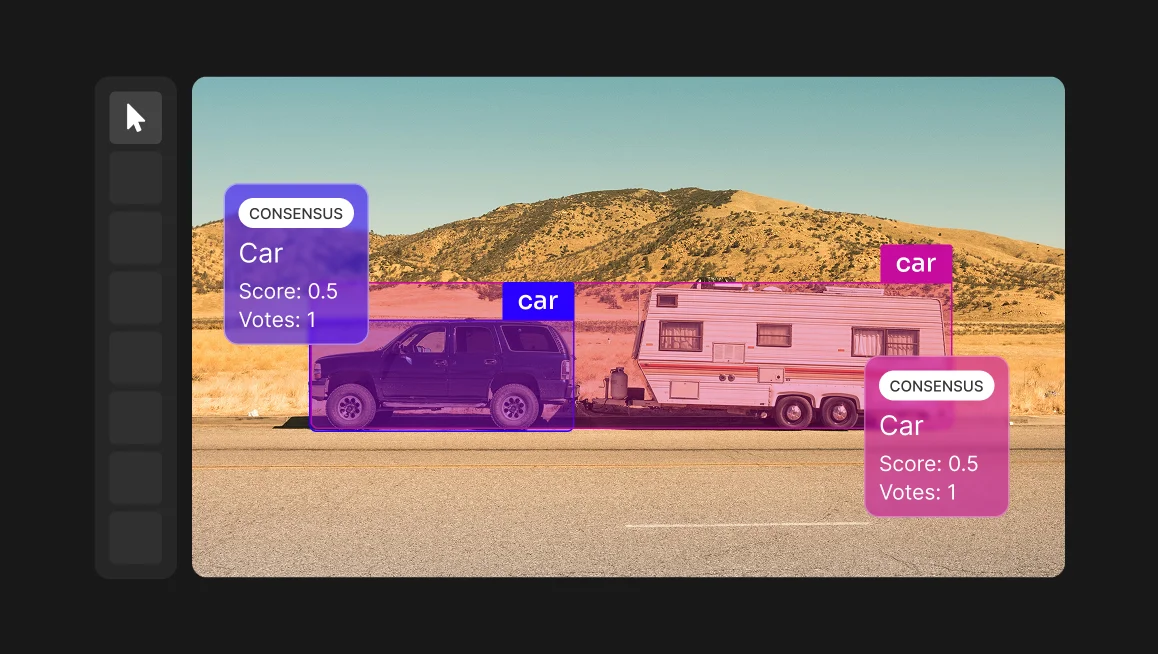
When building a dataset for semantic segmentation, inconsistent handling of edge cases will confuse the model during training. If half the dataset segments a reflection in a window as "background" and the other half segments it as the reflected object, the mode will not be able to produce a correct answer as well. To solve this, rigorous consensus mechanisms are required.
"In practice, we recommend having at least 3-5 experts to determine the best approach. When multiple perspectives exist, discussion helps reveal the strengths and weaknesses of each option and ultimately leads to the most scalable and consistent solution."
— Kais Mter, Project Manager, CVAT Labeling Services
By resolving these edge cases through structured consensus and updating the guidelines accordingly, you ensure that the semantic meaning of every pixel remains consistent across the entire dataset. That consistency is what gives the segmentation model the clean signal it needs to learn effectively.
Step 5: Measuring Dataset Quality
Since a segmentation model can only ever be as accurate as the data it learns from, annotation quality has to be measured before the dataset is handed off to training.
You can measure it two ways: how closely annotations match a trusted reference, and how consistently different annotators label the same image
The core tool for that check is Intersection over Union (IoU). For any two masks, IoU is the area they share divided by the total area they cover together, so comparing an annotator's mask against the gold-standard ground truth mask gives a precise score for how faithfully an object was traced.
IoU is a function that compares two masks. A single score tells you how close one annotation is to one reference. To get a dataset-level read, you aggregate those scores — averaging IoU across every checked image, per class, and across annotators on shared images:
Depending on the averaging used, you can get either a single quality score for the whole dataset or a set of numbers. Typically, scoring quality per class provides actionable insights about the annotations:
- When the scores stay high across every class and every annotator, annotations are consistent and faithful to the reference.
- When one class or annotator scores noticeably lower than the rest, that's the signal for which images need another pass.
If the annotator agreement is measured, a low score usually points to ambiguous guidelines rather than careless annotators. That makes quality measurement less of a final gate and more of a feedback signal: where scores drop, the guidelines get clarified and the affected images get re-labeled — as shown in the consensus loop from Step 4.
Ready to Get Started With Semantic Segmentation?
Semantic segmentation is one of the most powerful and demanding computer vision tasks, which means that if you are mapping urban environments for autonomous vehicles, segmenting medical scans for diagnostic AI, or classifying land cover from satellite imagery, precision is non-negotiable.
The good news is that the same platform and team behind this article are available to you at every stage of that work. CVAT meets you wherever you are, from your first practice mask to a fully managed production pipeline.
That flexibility matters because no two segmentation projects start in the same place.
Some teams need to prototype a labeling workflow before they commit to a single class definition. Others already have annotators in place and need the controls to keep thousands of masks consistent. And some would rather skip the build entirely and receive production-ready data on a schedule.
CVAT supports all three paths with the same underlying tooling, so you can move between them as your project grows without re-platforming your data.
Here is how the three options map to where you are:
- CVAT Online is an online platform where you can start annotating today with brush tools, polygons, and AI-assisted segmentation powered by SAM. It is the same platform trusted by over 200,000 ML and AI teams worldwide.
- CVAT Enterprise delivers the security controls (SSO and self-hosted deployment in your own infrastructure), team management, and scalability that production segmentation programs require. Your data never leaves your environment.
- CVAT Labeling Services provide expert-annotated, pixel-perfect datasets for teams that need high-quality segmentation data without building an internal labeling operation, backed by measurable QA KPIs and free proof-of-concept pilots.




.svg)
.png)

.png)




.png)